
Key Points
- Customs agencies are moving AI from pilot programs into core operations
- Risk targeting, valuation, and classification are primary AI use cases
- Governance frameworks indicate AI‑driven enforcement is permanent

Artificial intelligence has quietly crossed an important threshold in global trade enforcement. In 2026, AI is no longer an experimental tool at the border, it is an operational one. Customs authorities are embedding machine learning and advanced analytics into everyday workflows that determine which shipments move freely and which are stopped for scrutiny.
For logistics and trade professionals, this transition has immediate implications. Enforcement is becoming faster, more consistent, and far less random.
From Selectivity to Scale
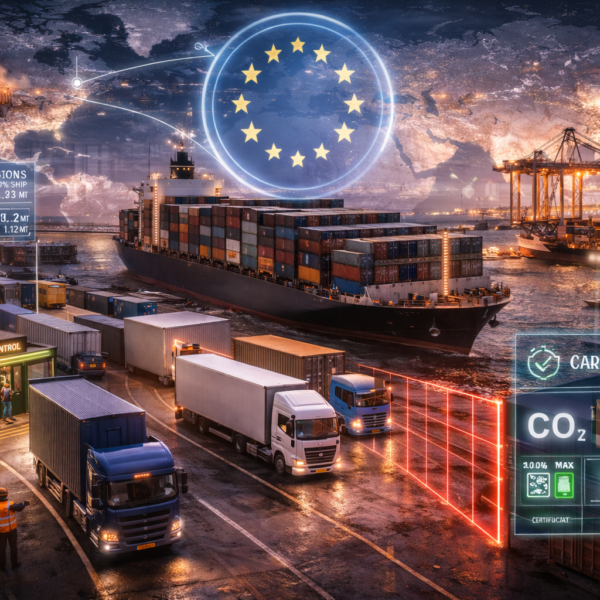
Customs agencies face a structural problem: global trade volumes continue to grow, while inspection resources remain finite. AI offers a way out of this constraint.
According to the World Customs Organization, AI and machine learning are now among the top technologies being adopted by customs administrations to improve risk management and trade facilitation (World Customs Organization, 2025). Rather than relying on static rules or random inspection, AI systems assess vast datasets in real time to identify patterns, anomalies, and correlations that merit attention.
This allows authorities to scale enforcement without proportionally increasing headcount.

What AI Is Actually Doing at the Border
Contrary to popular perception, AI is not replacing human judgment at customs. It is reshaping where that judgment is applied.
Key operational use cases now include:
- Risk targeting: Identifying high‑risk shipments based on historical behavior, trade lanes, and data inconsistencies
- Valuation analysis: Flagging under‑ or over‑valuation relative to market benchmarks
- HS classification support: Detecting classification patterns that diverge from norms
- Forced‑labor screening: Mapping supplier networks and entity relationships at scale
These systems operate upstream of physical inspection, influencing which shipments are stopped long before they reach a port gate.
CBP’s Governance Signal
In late 2025, CBP formalized its approach with a comprehensive directive governing AI use across the agency. The framework covers approval processes, lifecycle management, accountability, and reporting requirements (U.S. Customs and Border Protection, 2025).
This matters because governance is what turns innovation into infrastructure. By establishing formal oversight, CBP signaled that AI is not a temporary modernization effort, it is a foundational capability.
Compliance Becomes Predictive
For traders, the most important shift is conceptual. Compliance risk is no longer episodic or random. It is increasingly predictive.
AI systems compare current declarations against historical norms, peer behavior, and external data sources. Minor inconsistencies, previously unlikely to trigger attention, can now be flagged instantly if they fit a broader risk pattern.
This places a premium on consistency and data integrity across shipments, markets, and time.
Industry Implications
The operational consequences are already visible:
- Data quality becomes strategic, not administrative
- Manual compliance processes lose effectiveness
- Audit risk concentrates on patterns, not single errors
- Trusted trader programs face higher analytical scrutiny
For logistics providers, alignment between operational data and compliance narratives is no longer optional.
AI‑driven customs enforcement will continue to mature in 2026 and beyond. As models improve and datasets expand, enforcement will become more targeted and less forgiving of systemic inconsistencies.
The competitive advantage will shift toward organizations that treat compliance data as a core operational asset rather than a reporting obligation.
U.S. Customs and Border Protection. (2025). AI operations and governance directive. https://www.cbp.gov
World Customs Organization. (2025). Report on the adoption of AI and machine learning in customs. https://www.wcoomd.org