
Key Points
- A U.S.-sanctioned Chinese tanker transited the Strait of Hormuz despite the new U.S. blockade
- The incident exposes ambiguity in blockade enforcement and insurance risk
- Global logistics markets are now pricing geopolitical friction, not just disruption
In the early hours of April 15, a U.S.-sanctioned Chinese tanker exited the Persian Gulf through the Strait of Hormuz, becoming the first commercial vessel to do so since the United States began enforcing a naval blockade on Iranian ports earlier this week.
The transit did not involve a military confrontation. No interception occurred. Yet the implications are significant. The incident represents the first real‑world test of the blockade’s scope, enforcement credibility, and legal boundaries and it places global trade squarely at the center of a geopolitical standoff.
For logistics and global trade professionals, this is not a distant diplomatic episode. It is an event that directly affects routing decisions, insurance availability, energy markets, and the risk calculus underpinning global supply chains.




What Happened: A Narrow Transit With Broad Implications
According to shipping data confirmed by LSEG and reported by multiple outlets, the Rich Starry, a medium‑range chemical tanker owned by a Shanghai‑linked firm under U.S. sanctions, transited the Strait of Hormuz on April 14 after initially hesitating near Qeshm Island (Oil Price Live, 2026; MSN, 2026). [oilpricelive.com], [msn.com]
The vessel was carrying approximately 250,000 barrels of methanol loaded at a UAE port, not an Iranian terminal. That detail proved decisive. While the U.S. blockade targets vessels entering or departing Iranian ports, U.S. Central Command clarified that it “will not impede freedom of navigation for vessels transiting the Strait of Hormuz to and from non‑Iranian ports” (Reuters, 2026). [usnews.com]
In practice, this created a narrow but meaningful corridor through which the Chinese tanker passed—legally, but provocatively.
Beijing’s Signal: Trade Will Continue
China’s response was swift and public. Defense Minister Admiral Dong Jun stated that Chinese commercial vessels would continue transiting the Strait under existing trade and energy agreements, calling external interference unacceptable (IBTimes UK, 2026). [ibtimes.co.uk]
Chinese officials framed the U.S. blockade as contrary to global economic interests, urging restraint while signaling that Beijing does not recognize Washington’s authority to restrict its commercial shipping beyond Iranian ports (Reuters, 2026). [usnews.com]
This is not a declaration of confrontation, but it is a refusal to comply quietly.
Why This Matters for Global Logistics
From a logistics standpoint, the incident does three things simultaneously:
- Clarifies, but also complicates, routing risk
The transit confirms that non‑Iranian cargo can still move through Hormuz, but only within a narrow legal interpretation that could shift quickly. - Accelerates insurance and compliance pressure
Even when vessels are legally permitted to transit, war‑risk insurers may still impose additional premiums or exclusions due to heightened uncertainty. Coverage feasibility, not legality, increasingly determines routing. - Introduces selective enforcement risk
Logistics planners must now assume that enforcement may vary by flag, cargo origin, ownership structure, and geopolitical signaling, not just geography.
This is not a binary closure. It is a conditional chokepoint.
Amazon’s Supply Chain Power Play: What ASCS Means for 3PLs, Carriers, and Shippers
On May 4, 2026, Amazon made a move that sent shockwaves through freight terminals, carrier boardrooms, and logistics investor portfolios simultaneously. The e-commerce giant formally launched Amazon Supply Chain Services (ASCS) — opening its vast internal logistics network to any…
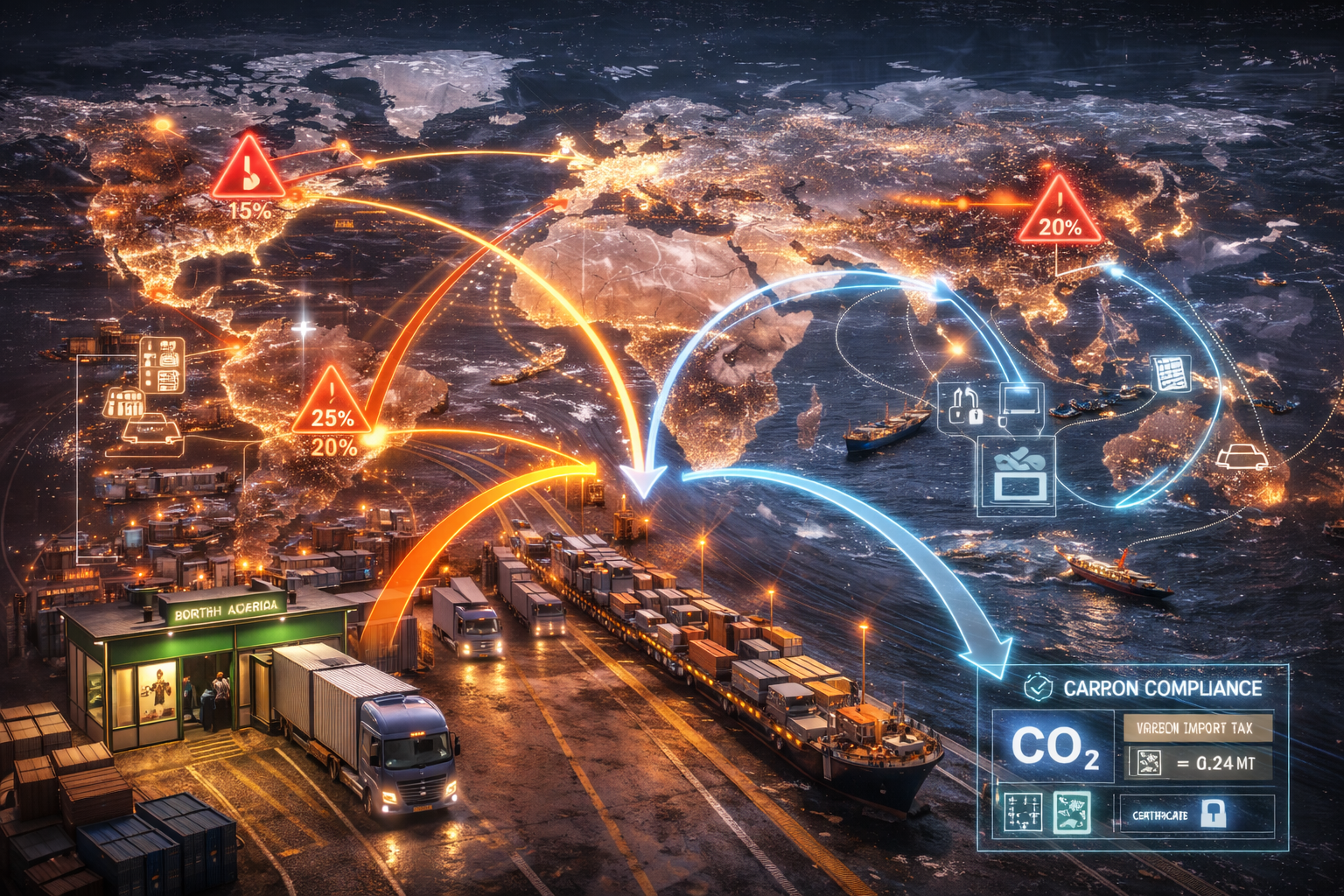
The U.S. Tariff Review Cycle Is Quietly Re‑Opening Supply Chain Risk
For much of the past two years, U.S. tariff policy faded into the background of supply‑chain planning. While tariffs remained in place, they were largely treated as a static cost rather than a dynamic variable. That period of relative stability…

Cargo Insurance Is Being Rewritten by Geopolitical Risk
For decades, cargo insurance functioned as a largely invisible component of global logistics. Premiums were predictable, coverage was broadly available, and insurance considerations rarely influenced routing or scheduling decisions. In 2026, that model has broken down. Escalating geopolitical risk, particularly…

CBAM Has Entered Its Data Enforcement Phase and Logistics Is Exposed
For the past two years, the European Union’s Carbon Border Adjustment Mechanism (CBAM) has been widely described as being in a “transitional” phase. Importers reported emissions, regulators observed data flows, and no direct financial penalties were imposed. That framing is…

U.S. Port Labor Risk Is Re‑Entering the Planning Horizon
Port labor disruptions tend to announce themselves loudly, through strike deadlines, shutdowns, and political intervention. The current risk environment is different. In April 2026, labor issues at major U.S. ports are resurfacing quietly, without a single dramatic flashpoint, and that…
Market Reaction: Energy and Freight Take Notice
Energy markets responded immediately. Oil prices initially retreated after the transit signaled that some flows could continue, but volatility remains elevated. Prior to the transit, tanker traffic through Hormuz had nearly halted following the blockade announcement (CNBC, 2026). [cnbc.com]
For freight markets, the signal is mixed. Carriers are reassessing exposure, insurers are repricing risk, and shippers face a moving target. Even if vessels can transit legally, the cost and insurability of those transits are no longer stable.
Enforcement Ambiguity Is the Real Risk
The most important takeaway for global trade is not that a Chinese tanker passed through, but why it was allowed to do so.
The U.S. blockade, as currently articulated, is narrower than initial political rhetoric suggested. That creates ambiguity. Ambiguity invites testing. Testing invites escalation or recalibration.
For logistics professionals, ambiguity is often more disruptive than outright closure.
Industry Implications
For logistics, trade compliance, and supply‑chain leaders, the immediate implications are clear:
- Routing decisions must now account for legal and insurance feasibility, not just distance
- Contracts and force‑majeure clauses should be stress‑tested
- Energy‑linked supply chains should plan for volatility rather than disruption alone
- Geopolitical signaling is now a logistics variable
This incident will be studied closely by carriers, insurers, and governments alike.
The Rich Starry transit does not end the Hormuz crisis. It defines its early phase.
Expect more tests by China and other major trading nations, and by market participants probing where the real lines are drawn. Whether the U.S. responds by tightening enforcement or preserving flexibility will determine whether this remains a contained episode or becomes a sustained logistics risk.
For global trade, the message is sobering but clear: strategic chokepoints are no longer governed by simple rules. They are governed by interpretation, signaling, and risk tolerance.
Oil Price Live. (2026). Sanctioned Chinese tanker breaks through US Hormuz blockade. https://www.oilpricelive.com [oilpricelive.com]
Reuters. (2026). China urges restraint over US blockade of Strait of Hormuz. https://www.reuters.com [usnews.com]
IBTimes UK. (2026). China challenges US blockade as vessels continue transits. https://www.ibtimes.co.uk [ibtimes.co.uk]
CNBC. (2026). Hormuz blockade risks deepening global energy crisis. https://www.cnbc.com [cnbc.com]