
Key Points
- Climate‑driven water constraints have structurally reduced Panama Canal reliability
- Shippers must treat Panama exposure as an ongoing planning risk
- Canal reliability is no longer taken for granted
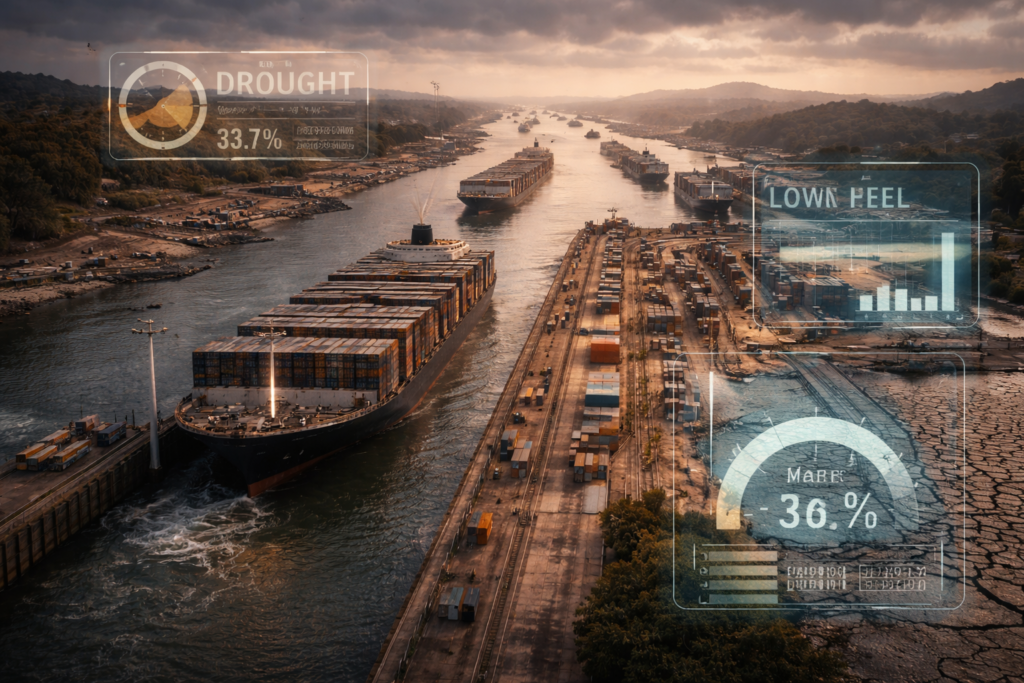
For more than a century, the Panama Canal functioned as one of global trade’s rare constants. Transit times were predictable, capacity was assumed, and routing decisions treated the canal as stable infrastructure rather than a variable input.
That assumption no longer holds.
Following persistent drought conditions beginning in 2023, water‑level volatility has continued to constrain Panama Canal operations through 2026. While daily transit limits have fluctuated, the larger shift is structural: canal reliability can no longer be taken for granted. For logistics professionals, this represents a fundamental change in network design assumptions, particularly for Asia–U.S. East Coast, Latin America, and energy trades.
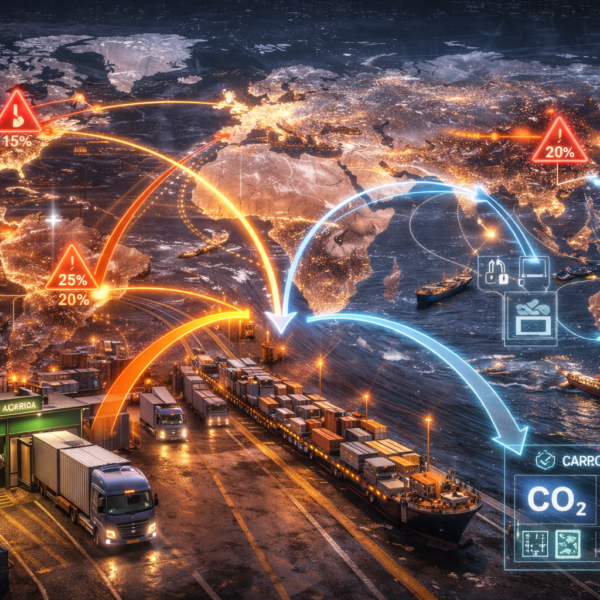


Climate Has Entered the Routing Equation
The Panama Canal depends on freshwater from Gatun and Alajuela lakes to operate its locks. Extended dry seasons and reduced rainfall have lowered reservoir levels repeatedly, forcing the Panama Canal Authority (ACP) to restrict daily vessel transits and impose draft limits (Panama Canal Authority, 2025).
Unlike short‑term congestion events, these constraints are climate‑linked and recurrent. Even when conditions improve temporarily, planning certainty does not fully return.
This marks a shift from operational risk to environmental risk.
Capacity Allocation Is Now Strategic, Not Neutral
During periods of restriction, the canal has relied more heavily on auction systems to allocate scarce transit slots. Auction premiums surged during peak constraints, with some vessel operators paying millions of dollars to secure passage.
This has two important effects:
- Capacity favors higher‑value cargo, distorting traditional cost‑based routing decisions
- Smaller shippers face reduced access, even if willing to absorb moderate delays
The canal is no longer a neutral conduit; it is an economically rationed asset.
Network Effects Extend Beyond Panama
Reduced Panama throughput reverberates across global shipping networks. When canal access tightens:
- Asia–U.S. East Coast services divert via Suez or U.S. West Coast intermodal
- Vessel rotations lengthen, absorbing capacity
- LNG, bulk, and container trades compete more directly for slots
These adjustments increase systemwide complexity and introduce second‑order congestion risks elsewhere.
Contracting and Inventory Assumptions Break Down
Historically, many shipper contracts implicitly assumed Panama availability. Transit‑time commitments, safety‑stock calculations, and replenishment cycles were built around stable canal performance.
In today’s environment, those assumptions introduce risk. Even modest canal disruptions can cascade into missed retail windows, production delays, or inventory imbalances.
The planning cost of uncertainty now rivals the freight cost itself.
Industry Implications
For logistics and supply‑chain professionals, the implications are clear:
- Routing strategies must include Panama‑free contingencies
- Transit‑time commitments should include climate‑risk buffers
- Inventory planning must assume episodic disruption
- Carrier selection should prioritize network flexibility over nominal speed
Ignoring canal variability is no longer defensible.
The Panama Canal will remain essential to global trade, but it will not return to its historical role as invisible infrastructure. Climate volatility ensures that water management and therefore capacity, will remain uncertain.
In this environment, resilient supply chains will treat canal exposure as a managed risk, not a fixed assumption.
Panama Canal Authority. (2025). Water management and transit advisories. https://www.pancanal.com
Reuters. (2025). Panama Canal drought disrupts global shipping. https://www.reuters.com